Not Traveling

Not traveling is a skill. It is acquired slowly, usually by traveling.

When you are not traveling, you are simply living. Although, you are simply living in a place that is not where you have ever lived, not where you worked, not where you raised your family.

Most often, it is a place that is totally new to you.

You are not rushing to see The Sights, to eat at The Best Places, to shop at The In Spots.

Right now, I am not traveling in Lisbon, Portugal. I am waking at 10:00, drinking coffee until 12:00 in an apartment on the third floor above a French bakery.

I am right across the street from the Museum of Antiquities. Though I have been here for 10 days, I have not yet been to this museum. In part, that is because I am not travelling. Instead, I am grocery shopping, doing my laundry, napping, reading and living in this apartment.

I am living. Not traveling.

Sometimes living can be tedious. Not traveling is rarely tedious.

This is because even the simple things, the grocery shopping, the laundry are adventures.

“How do I buy cheese here?” The cheese is all room temperature, displayed on the counter and it smells like Ron’s socks after tennis.
“How do I do laundry here?” The machine is so different, the loads so small.
“How do I cook dinner?” The pots are so large, the burner is so hot, the spices left for me in this cabinet are so fragrant.

When you are not traveling, it is best to take your cue from the locals. If the shops and restaurants close at 3:30 and reopen at 8:00, it is best for you to head on home at 3:30, take your nap, do your reading and writing and then come back out into the city center at 8:00.

Don’t try buying sunscreen at 4:00.

The only way you can enjoy not traveling, is to stay in a place for not less that two weeks. If you stay less than this amount of time, you will feel the pressure to SEE ALL THOSE sights. You may forget the importance of napping (this is an important skill).


Ron enjoys the recent eclipse.

Ron enjoys the recent eclipse.

And you may feel pressure and stress. This is bad. The best thing about not traveling is that there is very little pressure or stress. You have plenty of time.

Time to read, time to stare, time to think.

Next to reading, thinking and staring are my favorite things. It was the gift of not traveling that taught me to take a pillow and stool on to my tiny balcony and stare out on the plaza for an hour.

I have no schedule, no place to be, no plans.

After a lifetime of planning – career, financial, familial – having no daily plans is the best part of not traveling.

I want to see Sintra. I want to go the the beach in the fall. I’m not sure when these things will happen. Or if they will happen. Most likely they will, but if they do not it is OK.

I am not traveling. I am living.

That Twinkle

Apparently, walking the back roads of Galway during the evening implies a deep knowledge of the countryside.

It was my first evening in Ireland and I needed to stay awake just a few more hours to reset my body clock. I’d been awake for over 30 hours. So I took a short stroll in the cool air.

Marveling at the thick purple and red fuchsia in bloom everywhere and highlighted by the long evening light, I was stopped by two lost drivers. And one comedian.

Most were people about my own age with thick brogues. But for the clear tone of questioning that ended each statement, I had no clue what was being said other than it was indeed a question.

And that rising end tone told me that I should respond. The first time I was stopped for directions, I replied that I had been in the country just short of ten hours and that “not only can I not help you, I also have no idea where I am right now or how to get back to where I started”.

This answer was met by a great flashing smile, and a hearty laugh both from the driver and his passenger in the back seat.

“I can see you’re not good for much help all”, he grinned.
“I suppose not”, I replied.

The second time I was stopped I held up my palm, and told the driver straight off that I had no idea where I was let alone where they might be going. Again, this had us both laughing right away.

The third time a car stopped, it was the man who had been directly behind the second driver who had stopped me. Seeing my shrug, palm and smile to the driver in front, he offered to give me directions “anywhere in Tonabrucky” so I could better help the next person who stopped to ask.

My third good laugh in mere 10 minutes. Welcome to Ireland.

That evening I learned that my sense of humor, a deeply important trait that has pulled me though many an adverse occasion was born right here in Ireland. Born here and handed down from mother to daughter, for five generations.

Playful, self-deprecating, ornery, these are all parts of my own sense of humor and were easily shared with most of the Irish folks I met. Perhaps, our great, great, great grandmothers had been the closest of pals.

In the airport as we left Ireland, I watched an Irish father and his teenaged son in line with their bags. The son was bored, perhaps a little anxious. The father slid their bags along the floor until they pushed at the son’s shoes. A moment later, the son slid the bags back, up onto the father’s shoes. Back and forth the bags slid, each time further, each time, neither one looking at each other or smiling openly.

But their eyes said it all. I feel you, I love you, let’s have a smile together.

Thanks, Ireland. I am grateful to you for my sense of humor and playfulness. I’ll carry you with me.

Like a Boss

Ashford Castle in Cong, County Mayo boasts:

  • Fully restored to its historic splendour
  • 68 unique guest rooms with spectacular views
  • 14 luxurious staterooms and suite
  • Regular host to royalty, dignitaries and celebrities
  • The Huffington Post’s Top Hotel in the World for 2015

What it doesn’t say:

  • Occasional seasoned interlopers may be seen driving upon the walking paths

Yesterday we traveled to Mountbellow Woodland.  Best sign seen on the way:

“Bar-Restaurant-Undertaker-Funeral Home”

What more could you possibly need in one location?

As I noted in a previous blog, few walks in Ireland are marked, either the route itself or the trailhead. So after following the directions from the website to a T, we found ourselves in the parking lot of the Mountbellow Golf Club. No worries, the golfers were friendly folk and more than happy to provide us with directions.

Of course, the golfer’s directions did not include road names, just a “drive until the road bends, stop at an old forge and park your car”.

They did not mention that the old forge was The Old Forge, a tiny museum set up to showcase the Bellow Family, former estate owners. The museum is proudly staffed by Jimmy.

At 62, Jimmy is very proud of his heritage and took us through his small museum explaining all the farm equipment as well as putting it into context.

After a chat with Jimmy, it was time for us to head into the woods. These were deeply mossy, fern covered woods but with trees just decades old. As if I had not seen enough varieties of green, there were even more shades here.

image

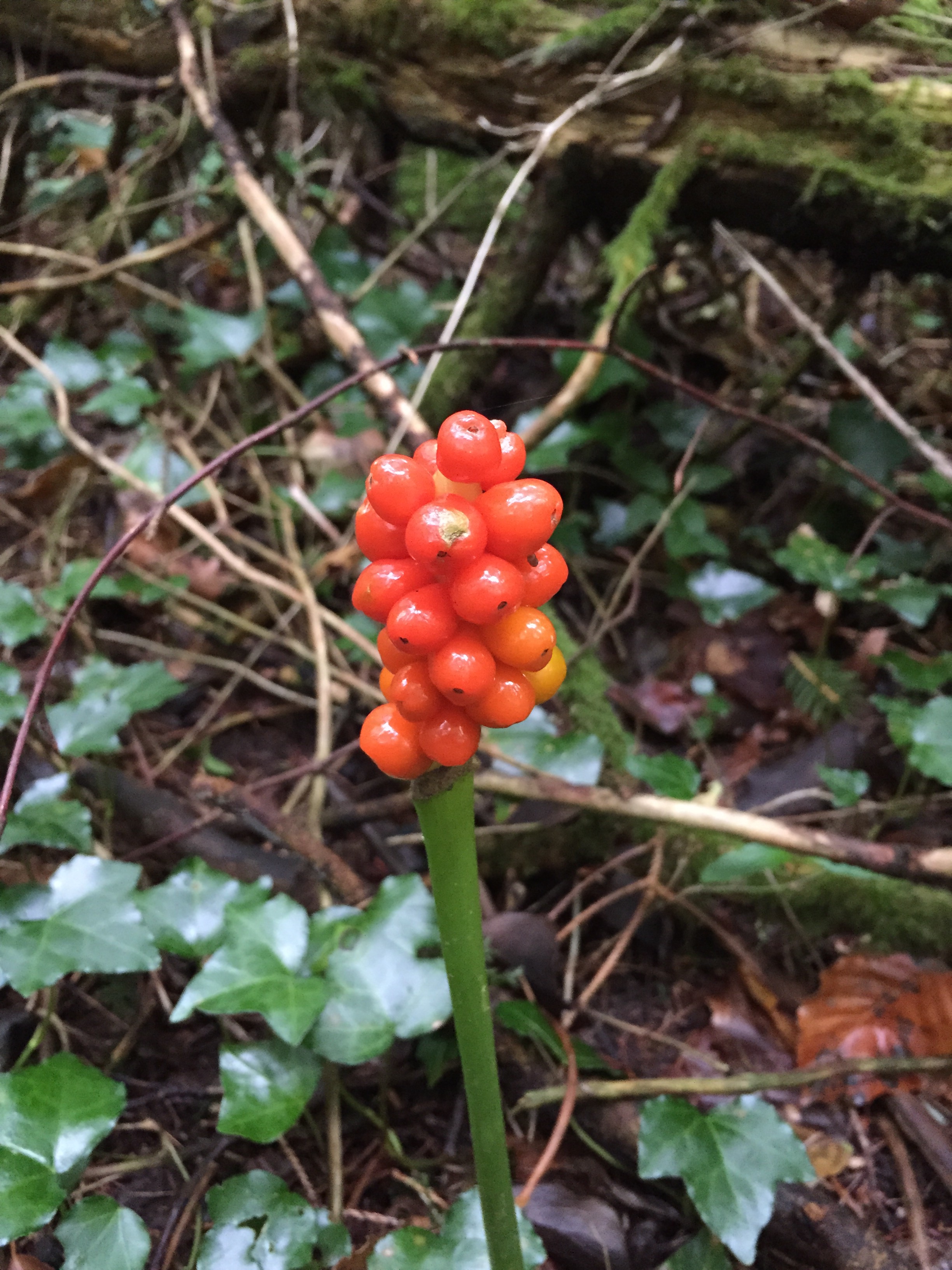
Here I saw trees totally wrapped in moss, two inches thick. And ferns the size of Elephant Ears. I also discovered an odd berry looking wild flower. Extra points for whoever can identify it.

image

After a short hike it was time for a long lunch at the local spot in Mountbellow town then back to Galway City via a different route. Always a different route.

We decided to go via Cong (because I wanted to meet the King, King Cong. A request made ad nauseum mostly to force Ron to make his thats-so-stupid face. Bwahahah!)

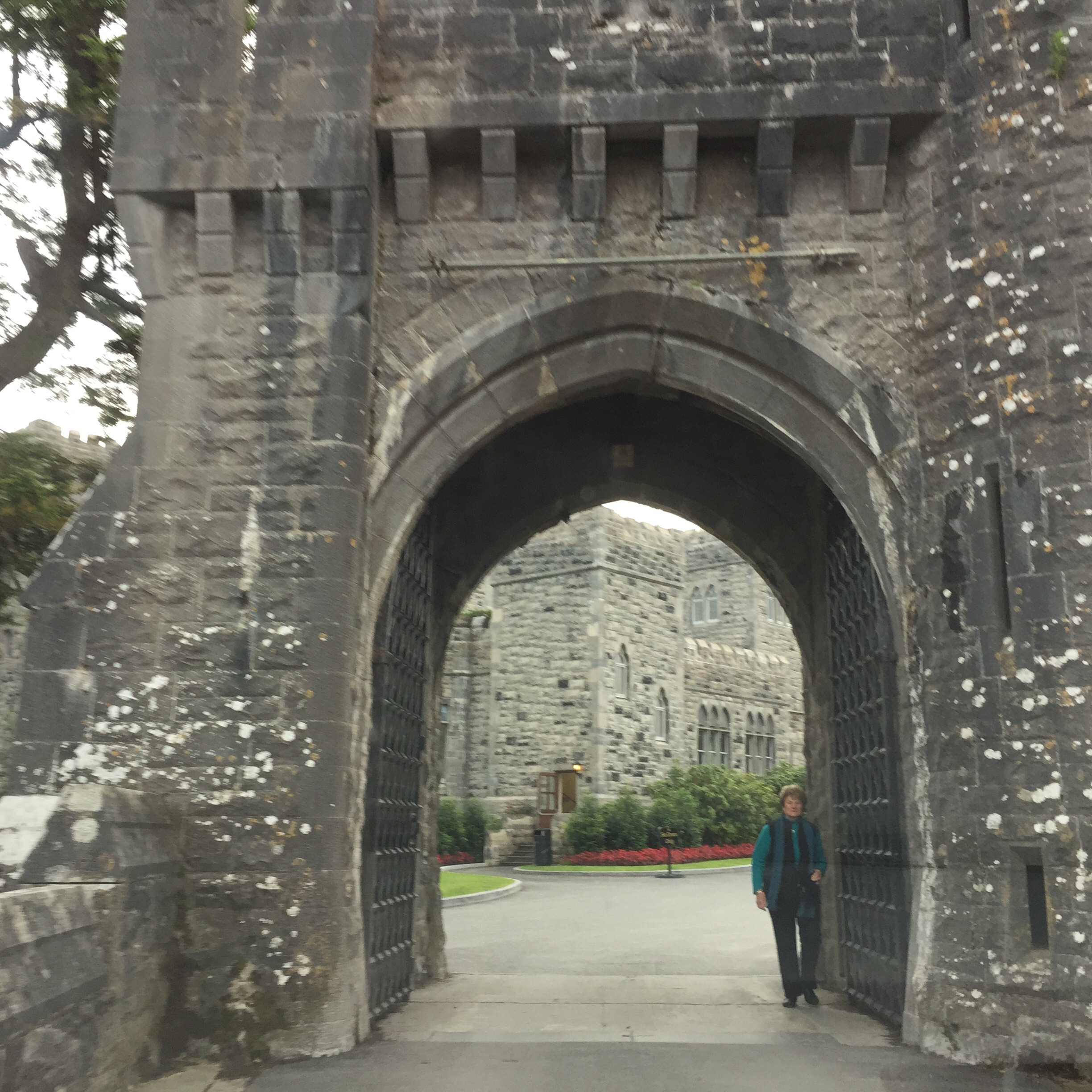
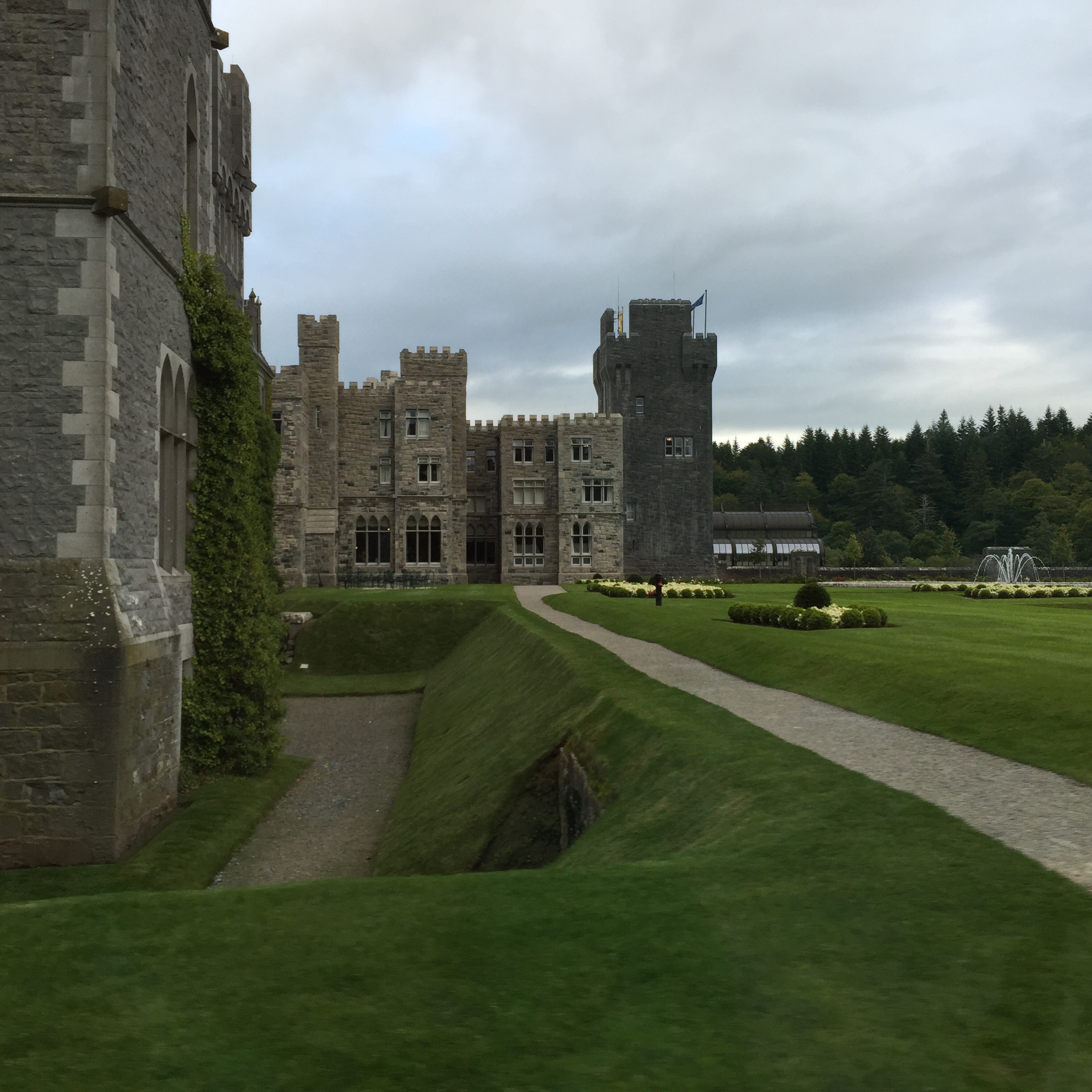
Just before entering the Village there was a turn off for Ashford Castle. We knew nothing about Ashford Castle other than it looked super cool! So we drove the one way road (not un-common for here) onto the property.

Whoa. Serious wealth. Expensive cars. People dressed to the nines. Fahncy shmahncy.

image

Located on a lake, the castle was built in 1228 by the House of Burke, fought over during the next three centuries and finally purchased by the Guinness family.

This is the real deal people. It actually had a small bridge across a stream leading to the elegant front doors.

But alas, no draw bridge. Silly them.

At the sight of a castle surrounded by 350 acres of paved walking paths winding their way through gardens and fountains, their velvet rope barriers casually dropped next to their posts, forty five years fell from our souls.

image

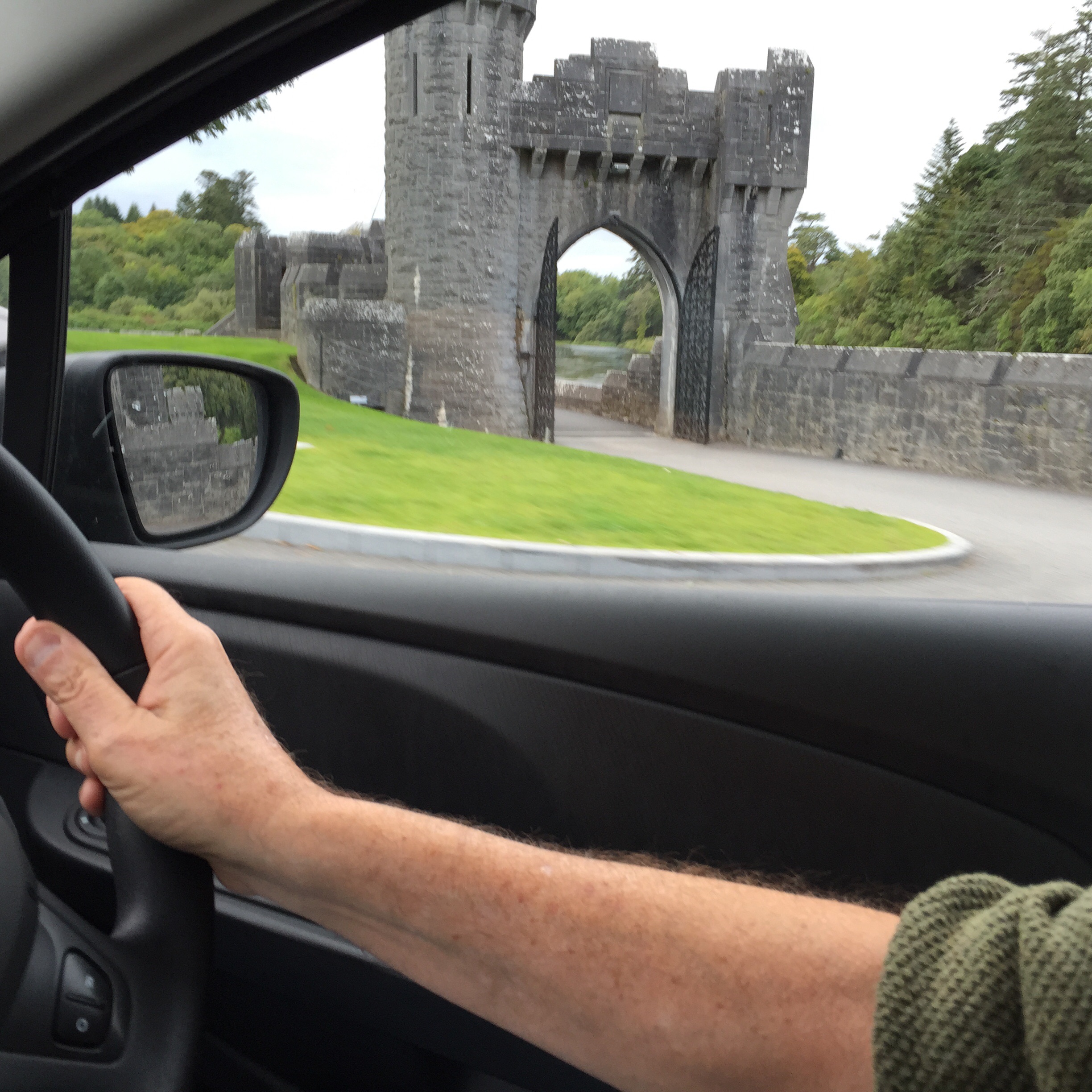
“Um, is this a road?” I asked?

“Might as well be”, responded the Ron, now directed by his inner 19 year old. And then  he drove on like he owned the place.

image

And so we toured the paved walking paths winding through 350 acres of the elegant Ashford Castle. In our tiny Renault.

And yes, we gently nudged several well dressed patrons into the grass.

They must have thought we were making deliveries.

“Hey, is that a clay tennis court?” asked an excited Ron. “Lets go see!”

Down a side path we zoomed, checked out the courts and continued along until we reached the back of the Castle, a number of workmen. And a dead end.

image

“Jig is up”, I lamented. “Unless you can do a K turn on this beautiful soggy grass without turfing it.”

“No problem”, replied Ron and then executed a textbook K turn without so much as a single clump of turf leaving the lawn.

By now the workmen were speaking into radios and glancing anxiously in our direction. So back to the bridge we headed, a few more middle aged ladies nudged into the grass, past the tennis courts, back over the one lane bridge and off to Cong Village.

Looking back in the rear view mirror we decided we’d been thrown out of better clubs than this.

Errisbeg

Yesterday we took another walk in the countryside. This time down by Roundstone. A walk to a mountain called Errisbeg.

A quick note about walking in Ireland. Most of the land is privately owned, few parks. And so most walking is dependent upon the graciousness of the land owners who are mostly sheep farmers. A few rules are in order:

Open a gate, close a gate.
Leave no trash.
Don’t bring dogs (sheep and dogs have a long and complicated relationship.)
Know how to use a compass (I do not…)

And also, don’t expect to find well-worn paths in most places. It’s heather jumping and scrambling from rock to rock with your eye on the prize up above. And a fixed point to return to on the way back.

This last part we learned yesterday. The hard way. Which is to say we did not have one.

So we drove an hour or so to Roundstone passing streams and lakes overflowing (literally, on to the road…) from two days of hard rain. A gorgeous drive (Ron is getting tired of my exclamations of “gorgeous!” and appreciates an occasional “stunning!” or “fabulous!”).

The town of Roundstone is small and gorgeous (!) with pastel colored two story buildings located on the bay and surrounded by lakes, stunning (you’re welcome) beaches and mountains. We decided that a lovely summer could be spent in a rental cottage here. Make a note.

We followed the directions in our 15 year old guide book “five kilometers westward from town to a sharp bend in the road, just before a rock quarry”.

Nothing was marked. No sign “Errinbeg Trail”. No “walkers welcome”. No “here ya go, Ron and Sara”. But there was a gate and there was a sign that said No Dogs. That sign is what assured me we had the right place.

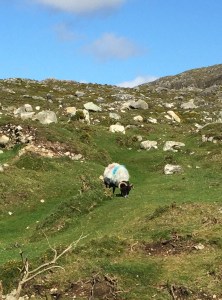
So we opened the gate (closed it carefully) and began to walk down a rocky dirt road. Under the watchful eye of red and blue sheep.
image

I’m not exactly sure why the sheep are spray painted in Ireland. A Google search found a suggestion that the blue ones are boys, the red ones are girls and the pink ones are gay. This sounded reasonable enough to me.

After 40 minutes of walking it was time for our first “discussion”. Ron insisted that we needed to leave the rocky road and bushwhack our way to the top. Raised as a hiker in Appalachia, seasoned in the Rockies, I had learned that bushwhacking is never a good idea.

But I had yet to write the fourth paragraph in this blog and thus had not yet read it.

Finally, I was convinced that walking over rocks and heather (called “bog hopping” in one of our books) would be our only way to ascend the mountain. So after fixing our eyes on a rock outcropping above (the Stonehenge Thing Up There) we walked up.

image

This is where I should mention that one of us was wearing waterproof hiking shoes. The other was wearing tennis shoes (ones actually used to play the game of tennis…) that had been retired due to holes in the toes from serving. I’ll let you figure out which was which. Needless to say (but I shall say it, over and over and over…) one of us had warm, dry feet while the other spent the entire day with cold, wet feet.

We reached the goal (The Stonehenge Thing Up There) and were rewarded with a gorgeous (well, it was) view of the cold Atlantic, and many lakes and bays. And down below were old, old rock walls and rolling hills of yellow (I think it was…) heather.

When it was time to descend, that’s when we realized that we should have picked a landmark to direct us back to the road. But alas, I had not yet written paragraph four, let alone read it.

So we picked our way using the sheep as markers. Bad idea. They kept moving away from us… Finally we saw a little sliver of the road and made some assumptions about where it might be going. Thankfully our assumptions were right (phew) and we were rewarded not only by the road itself, but several small waterfalls.

With only one fall each, mine resulting in a wet knee and Ron’s resulting in a skinned hand (it shall be noted…) we were quite proud of our 60 year old selves and our hiking adventure. But then pride turned into humility when a turn in the road revealed an elderly gentleman in a wool cap using a cane. No, not a hiking stick, a cane. For support.

When we got within hearing distance (which was quite close as this gentleman wore two hearing aids) we learned several things. One, the road ended a mile ahead at a river. Two, the gentleman was retired after working at Guinness in Dublin. Perfect. He had “made the dark brown stuff” for thirty years and retired to his birthplace “just a wee bit” down the road.

Back in the car (gate opened and carefully closed again) we drove eastward with the mountains and lakes directly in front of us. Poor Ron had to watch the (wee) narrow road carefully while I looked around and gasped as each bend in the road revealed something else more amazing than the view before.
image

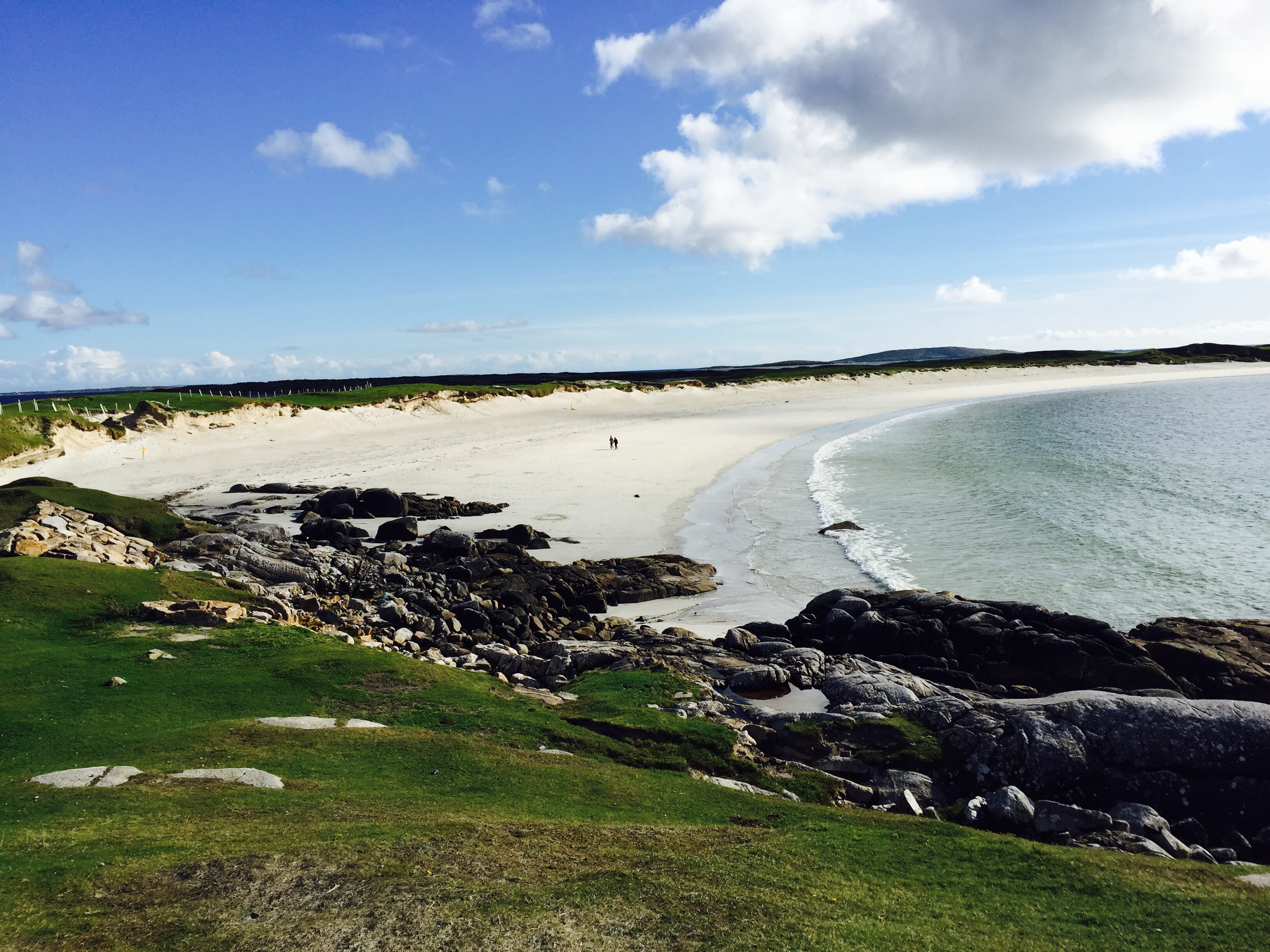
That’s when we came upon Dog Beach. A beautiful stretch of white sandy beach made entirely from the shells of 1000 year old crustaceans and now containing just a few walkers. But, alas, no dogs. A stop, a walk, a conversation with a couple of Brits and we were back on the road in search of a pint and a bowl of stew or chowder.

We found it at a hotel in Roundstone. The stew was made of lamb (neither red nor blue) and root vegetables. The pint was VERY cold. And the bar contained a British traveller sharing his photos of Texas with a very bored couple, also from England.

Back on the road and the views just kept getting more and more gorgeous.

image

Why would anyone leave this I’ve-run-out-of-synonyms-for-goregous country? it would need to be an indisputable reason. Like starvation. The great motivator of masses.

With crops being ruined and large families to feed, even the sea could not keep up with hunger and the people fled. To America, to England to where-ever they could to stay alive.

But some stayed. And many more returned. Even if, like me, it was four or five generations later.