Missing You

Dear Kids,

You are now all grown. Living on your own, building lives, businesses, relationships.

I’d like to leave a few things with you to hold for me as I travel. Sorry about this, but I could really use your help to free up some extra space.

Not much. Just a couple of things.

First, I need you to hold some worry for me. You see, my life has been inextricable linked to yours for the past 28 years. Your well-being has been foremost in my heart.

Though you are not part of my daily life, I carry you with me.

Did you eat well today? Are you happy? How is your life going? Did you experience joy this week? Did you learn something that blew your mind wide open? Are your flowers flourishing? Does someone else love you?

I’d like to eat a warm biscuit and not wish that you could taste the salt and butter. I would like to see a lacey, white blouse and not think how perfect you would look in it. I would like to hear a story and not want to talk to you about it.

And second, will you hold on to some memories for me? I need the room to make some new ones.

I hiked today and compared it to the hike that we took together years ago. It was your first ten mile hike. Remember? The one with the lake where an upside down mountain lived. Not the one where we swam unexpectedly and then drip-dried, watering wild flowers all the way down the mountain.

Can I leave these memories with you for a while?

here is the deepest secret nobody knows

(here is the root of the root and the bud of the bud

and the sky of the sky of a tree called life;which grows

higher than soul can hope or mind can hide)

and this is the wonder that’s keeping the stars apart

i carry your heart(i carry it in my heart)*

I’d like to leave these things with you while I wander. You good with that?

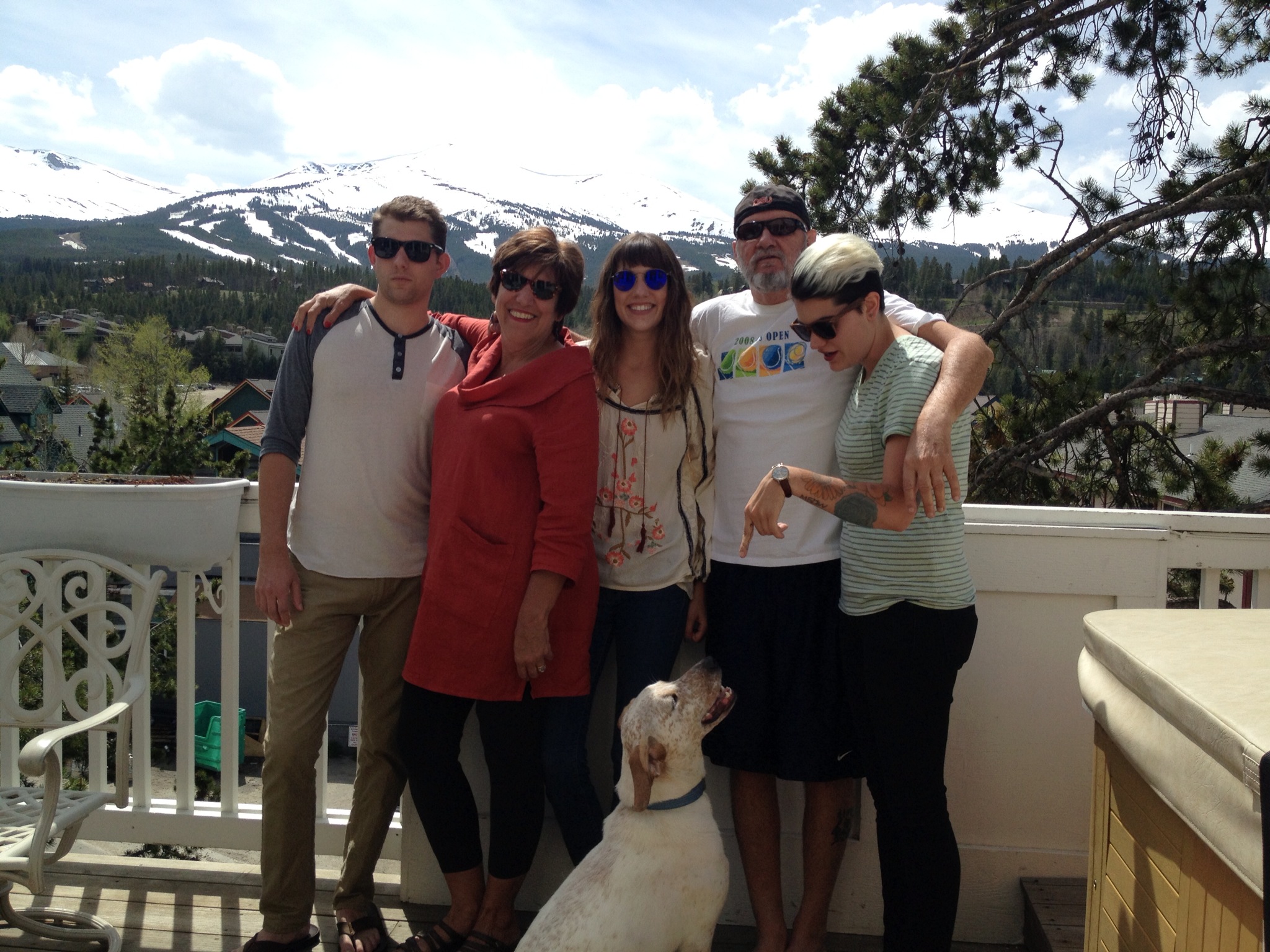
The fam summer 2015

* ee cummings

Eating Healthy. Or Not.

I used to love to cook. I was good at it. And it was truly source of pride for me that I was the head cook in my household. I was 12.

Back story: My mother had just taken a job as a dean at a small local college and this was her (very smart) way of keeping her latch-key kid busy. Pre-microwave, pre-packaged food, I arrived home at 3:00 and was to have a wholesome meal on the table by 5:30.

BACK-back story: This was back when parenting was more about making kids trustworthy than protecting them.

Feeding oneself in a healthy manner is an important skill. I am learning to be nomadic again and eating healthy has presented a problem.

I would much rather pop into the local pub, sit at the bar and order a cocktail followed by an appetizer, (another cocktail…) and perhaps a meal. The bartender needs to be chatty, the drinks and food need to be local and all three need to add color to my experience of that place.

This was not a problem when I wandered 30 years ago. But now, at 60, I am TRULY what I eat. It shows up in my cholesterol. And on my butt.

So here’s the problem: How does one eat healthy while traveling full time?

What fun is turning down an enormous homemade biscuit with strawberry rhubarb jam for un-buttered toast and a bowl of strawberries?

This was the month I was supposed to take back control over my diet. The place I am renting is owned by a woman who cooks. I mean really cooks. Every tool one could want is in the kitchen is here. Plus a spare.

AND there are multiple, wonderful farmer’s markets just moments away. There is NO EXCUSE for not cooking here.

Yesterday I cleaned out the refrigerator. Veggies and fruits straight into the bin. Sinful.

“Just make healthy choices, Sara”. I know. I know…

But after a day of hiking or urban exploration I get hungry. Really hungry. I like to find a small café, full of locals. A place where the café patrons provide entertainment, where the local culture is reflected in the menu. And when I find these places (and I always do), a tattooed woman will hand me a menu. And BOOM!

Brisket, IN MY FACE!

Chicken-friend bacon, IN MY FACE!

Local lager, hand crafted cocktails, ALL IN MY FACE!

I know I should be able to turn my back on local specialties, on happy hour deals, on pizza THE SIZE OF A DESK.

I should be thinking of health. And of salad. Of club soda with lime. Of lean cuts of sauce less meats and plainly steamed vegetables. I should say a firm “NO” to all potato based foods.

I should absolutely NOT be experimenting with BBQ pork and kimchi burgers or even looking at homemade ice cream sandwiches with freshly baked chocolate cookies and locally made fresh mint ice cream.

Right? RIGHT?!

Just tell me what to do, Dear Reader.

As a seasoned human, this is a true dilemma for me. I need your help. I know how to manage my health. I know how to cook. And I am choosing not to.

Yes, I am weak. Very weak. But I have some delicious stories to tell….

Museum Ready

For some wanderers, art museums are a must. That’s me. I usually get a good sense of a place by how a community celebrates local art and how much they value recognized art.

So we did a rainy-day art museum exploration in Denver. Wandering through the impressive building, we found ourselves walking between two diverse groups. One was a group of elderly persons being pushed in wheel chairs and the other was a family of toddlers in strollers.

Beyond the wheels, the similarities were striking. Both groups were being “schooled”.

“This is what the artist is saying.”

“This is how it makes me feel. How does it make you feel?”

The most obvious difference between the two groups was volume. The toddlers were spoken to in the softest of voices. While the elders were virtually screamed at.

At one point a well-dressed, elderly man asked his attendant if she would like to change places with him. He was certain that the constant wheelchair pushing was wearing her out. Instead of graciously declining, the woman laughed. Laughed at the stunned elder man. I was sad for him, his loss of respect and unobserved grace.

At another point, a toddler squeezed his eyes tightly shut and leaned back in his stroller. He was then firmly lectured by his father that he would be unable to see the beauty around him unless his eyes were open. I was sad for the child, his overload and disrespected sense of what he needed.

Call me crazy [YOU ARE CRAZY, SARA!] but I believe that allowing people to feel their own feelings is important. Especially when it comes to viewing art. And experiencing kindness.

“Ah, you are so thoughtful, Mr. Grey. I would love to switch places with you for a few moments. But we are nearly done and I need the exercise. I do, however, appreciate that you are thinking of me.”

“Oh my, sweetie. Yes, there IS a lot here. Close your eyes, if you wish, think and feel all the feels.”

Art inspires me. It incites me. It rejuvenates me. It makes me exhausted.

I like to wander museums and stare for as long as I need, sit for as long as I must, even lay down when I need to. (Yes, this later behavior does indeed elicit strange looks or commands from museum personnel on occasion.)

The difference between me and the groups I was following and preceding is that at the magical age of 60, I see myself as museum ready. I believe I have earned the right to enjoy as I wish, in the manner that suits me. Unless, of course, it interferes with someone else’s enjoyment.

And, the cherry on top, is that I don’t care about how this may appear to someone else.

In one exhibition, the artist’s goal was to recreate the feelings of home. The area was carpeted in colorful squares, transparent plastic words hung from the ceiling, moving gently so that at one time some words were readable and others not. A moment later, a small movement and different words were readable. It was a colorful reminder of how our sense of home changes.

Words in a variety of languages were made into large, soft pillows strewn about the exhibit. And in the middle were three huge round, black floor pillows.

As a wanderer, this exhibit hit home (sorry…) for me. Is home a destination? Is it where your “stuff” is? Is it where your history took place? How does home happen? Is it a place you discover? Or, is it something you make?

Each time I unpack my bags into another closet, fill another pantry with my foods, curl up in a new chair to read my book, I feel oddly at home.

Home is now the place where I allow myself to release, to rest, to pause.

As others stood uncertainly at the entrance to the home exhibit, I entered it. I lay down upon the huge black pillows, felt the reprieve and the comfort they provided and opened myself up to the rest.

And oddly, I became a part of it.

“Look, at that lady. She looks relaxed.”

And I was. For a few brief moments, I truly was.

Belonging

I belong to a Facebook group for international nomads. These are people who travel the world and have done so for many, many years.

Most are younger people with professions that allow them to work from anywhere, writers, IT or finance professionals. They call themselves location-independent. Few of them are seniors. And, amazingly, there are over 1600 of them in just this one FB Group.

Last week a woman posted this: How do you deal with loneliness? How do you find community when you are always moving? How do you achieve a sense of belonging?

She then posted a story about a holiday meal shared with a family that she had just met. “I felt like they pitied me”, she wrote. “It was a sad way to spend the holiday.”

While we have officially only been on the road for six weeks, this is our second time around. And we spent the last four of the past six months not-at-home. So, I get this question.

In addition, I spent over 15 years as a religious professional, working for two different Unitarian Universalist churches. I learned that when people initially come to church it is often to find a place to belong. A place where their opinions are welcomed by folks who share their values. A place where just showing up to be part of something bigger is what the church provides.

“Where is Bethany?” someone might ask on a Sunday morning. “She was at playgroup on Thursday and went home early with Laura. Another ear infection, I think”, someone else might offer.

Bethany is missed. And accounted for. Bethany is part of something bigger, beyond her small family.

Is it possible to achieve belonging on the road? What do friendships look like when they last only days? Is happy long term travel possible for people who need community?

[Insert answers here]

I don’t have the answers to these questions, and I’m not sure that I will anytime soon. There are greater minds that have grappled with the huge idea of belonging.

But I do know this: belonging is the basis of most communities. And belonging is right in the center of our human hierarchy of needs. Some of us seek it out. Others claim not to need it and instead cope without it.

Pull the belonging block out of the center of the Maslow’s hierarchy of needs pyramid, and the esteem and self-actualization blocks come toppling down.

Does the single person have stronger needs for community than the coupled person? Does the senior have less? Does the parent have more?

[Insert answers here]

So let’s suppose one of the roles of the nomad Facebook group is to create a sense of belonging for a group that shares values. Can’t we also support our need to belong through Skype, or by posting, blogging, texting, and calling? Is that enough?

All of the communications above were not possible when Ron and I travelled the globe the first time. We wrote letters (!) sent postcards and called home for ten minutes once a month.

In those days, travelers became each other’s community quickly. If we were travelling west, we sought out the eastward traveler and picked her brain. If we met someone whose company we truly enjoyed and we were traveling in the same direction, we travelled together for a while. We shared stores (and meals, new adventures). But it was the stories that formed the basis for our communities.

“Oh my gawd, last month we hung out for a week or so with this American dude who grew up in Morocco. He was dark eyed, dark haired and spoke fluent Arabic. Blended right in. Super nice guy. And handy to have along in the medina!”

“We spent last week travelling with this couple from The Netherlands. Super fun. And the Dutch are fabulous travel partners, they all speak about four languages!”

“You stayed at [insert name of] hostel also? Did you meet Marco? He is the crazy-thriftiest traveler ever. Cooks his own food here in Thailand just to save forty cents.”

These were the stories that formed the basis for most of our new travel communities.

You did that? Oh-my-gawd, so did I! You felt that? Oh-my-gawd, so did I, (I’m not the only one.)

I’m not the only one… The basis for belonging. The basis for community.

Can we find community while traveling in 2015? Will we find it face to face or virtually? Do we need it?

We’ll keep you posted.

When In Rome

Colorado is known for having many recreational activities, hiking, skiing, biking. And now, weed.

In Breckenridge, the weed emblazed T shirt with the snarky saying is front and center in most shop windows. Rocky Mountain high is legal and back in style. The state is booming.

While known to dabble, weed is not my favorite inebriant of choice. I have some very strong Irish stock which moves me more in the direction of wine, whiskey, and scotch.

Last week I had my hair cut in Breckenridge by a young woman who, while making small talk, asked what I had done so far in Colorado. I talked of the awesome hiking, the delicious dining and the dispensaries.

“You went to the dispensaries?” she asked. “That’s so cute.”

Cute? Excuse me?! In 1973 I was living in dorm rooms that were a grey haze much of the time. Now I’m not saying that was (always) a good thing. But it was a typical thing to do.

Youth is a time for experimenting, sex, drugs (rock and roll) and, if managed, experimentation is an important part of growing up.

(Now, before you get all Nancy Reagan on me, YES, I know pot and drugs can be a problem. I have experienced it directly in my family. It can be a problem just like alcohol.)

And as a traveler I have tried kava in Tonga, mescal in the Yucatan and (Ron) betel nuts in Burma. So, weed in Colorado? Why not.

To me, the most fun thing about weed was shopping for it. Paranoia free purchasing.

We were greeted at the door by security. This person’s job is to make sure there are only as many people in the dispensary as there are Bud Masters. Bud Master? That’s the pot equivalent of a wine sommelier.

The Organix dispensary was busy, so we needed to wait for a few moments in the comfortable waiting area that, but for the ads for Orange-Chem and Grease-ball, reminded us of the orthodontist’s office where much of our time was spent years ago.

A small group left, the door to the dispensary was unlocked and we entered. The space was open and sparse. Virtually everything in the dispensary was behind glass cases and in cabinets on the walls behind the Bud Masters. Only the odd T-shirt and weed emblazoned socks were hanging on familiar display racks where customers could handle the merchandise. Everything else was not accessible without help.

Vape pens, pipes, papers, tincture, edibles, and good old fashioned smoke-able weed was all on locked display.

We were greeted by our young, twenty-something, tattooed Bud Master. “How can I help?” she asked.

The friends I was with had downloaded the Leafly app onto their phones and knew exactly what they wanted. One eighth of Dairy Queen. D0es Dairy Queen know their name is on a strain of weed? Probably not. But maybe so…

And isn’t is interesting they don’t mind? Munchies, anyone?

The place was immaculate. The staff professional, their dreads clean and colorful. Even the dispensary dog was clean and well behaved.
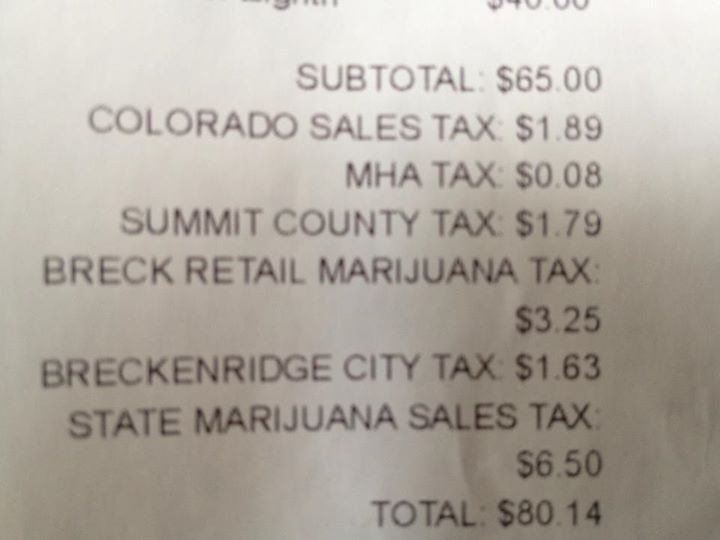
10686889_10207473468973982_3075388608834991962_nWe left $80 lighter, $15 of which had gone to the State of Colorado, the City of Breckenridge, and the county of Summit.

According to an article in the Washington Post (February 2015), the weed business is a $700 million dollar industry according to the Post’s analysis of recently-released tax data from the Colorado Department of Revenue.

“In 2014, Colorado retailers sold $386 million of medical marijuana and $313 million for purely recreational purposes. The two segments of the market generated $63 million in tax revenue, with an additional $13 million collected in licenses and fees”, reported The Post.

The economic impact of the marijuana industry is actually even greater, as the figures above don’t include retail sales of related pot products, vapes, pipes, T shirts, nor do they account for increased tourist traffic.

One afternoon while we sat watching the Blue River roar past full of newly melted spring snow in a Breckenridge park, we were approached by an earnest young man.

Would we agree to participate in a short survey? Um, sure.

It was a twenty question survey. The first ten were about basic tourist services. The last ten were about how much legalized weed influenced our decision to come to Breckenridge. Clearly, marketers want to know.

Now with an entire year of data behind them, Colorado has a clearer picture of the impact of the marijuana market. Total marijuana tax revenues are expected to climb to $94 million by 2016. This means a $1 billion dollar retail weed market. That’s not chump change.

And, few of the dire consequences some feared have occurred.

According to The Post, “Fatal car accidents in the state are flat, and well below the past-decade average (not terribly surprising, considering stoned drivers are considerably safer than drunk ones). Crime is down in Denver and the surrounding area.”

In the good old, USA, capitalism rules. And with money like that on the table you can bet your Dairy Queen that other states are paying close attention.